
Blogger
Oct 07, 2026
48 Views
0 Comments
When we think of high-mountain or arid landscaping, what first comes to mind are gravel flows, cacti, and flagstone slabs. They are essential and aesthetic elements, but there is an invisible layer of gardening that is rarely discussed: urban microclimatology and thermal comfort.
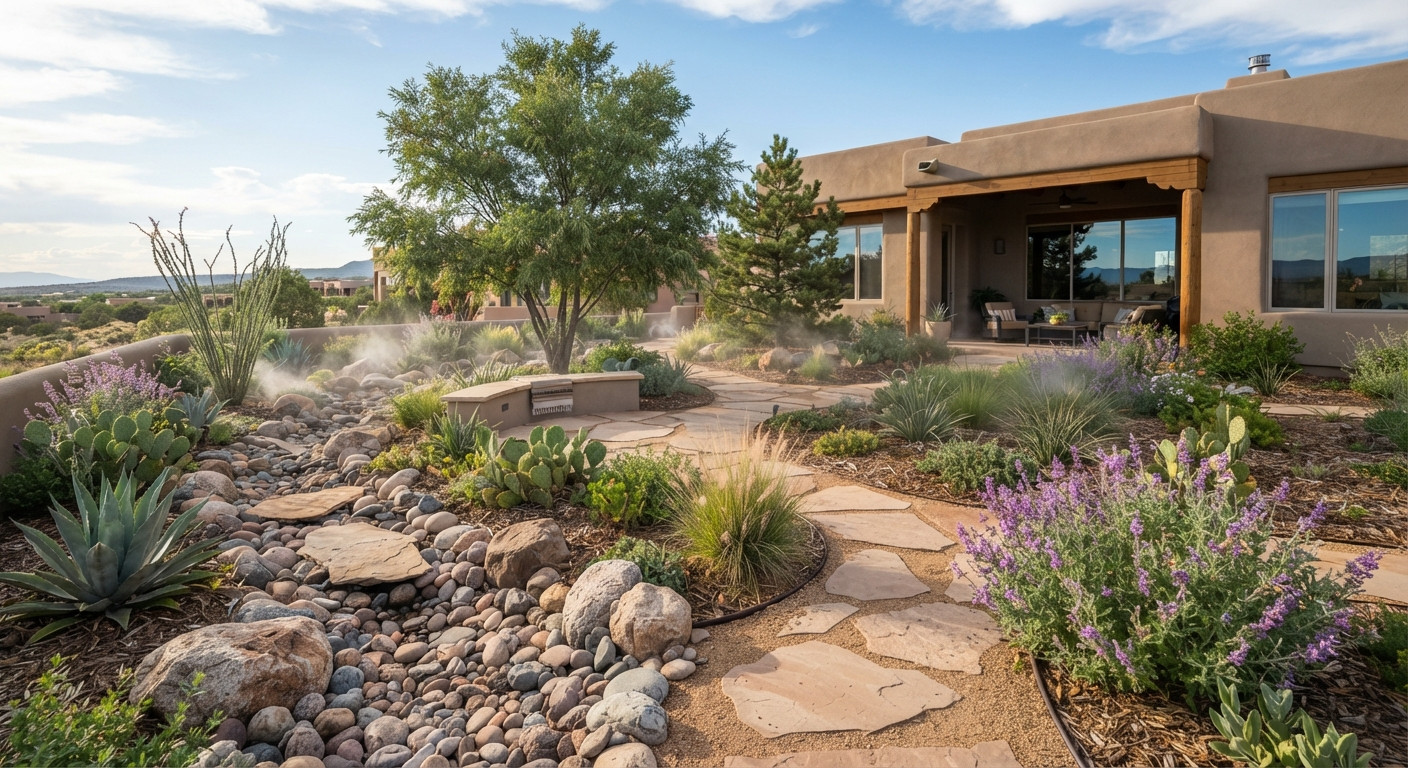
A well-planned desert garden is not just a pretty space that saves water; it is an active thermal shield capable of transforming the atmosphere around your home.
The "Heat Island" Effect in Residential Yards
Many homeowners make the mistake of surrounding their houses with 100% mineral surfaces (dark retaining walls, massive extensions of unshaded crushed gravel, and large paved areas). Although this eliminates the thirsty lawn problem, it turns the perimeter of the dwelling into a veritable heat-plank during summer afternoons. Stone materials absorb solar radiation all day long and slowly release it at night, keeping the house warm.
Invisible Design Strategies to Cool the Environment
To break this cycle and achieve a true oasis, modern designers are applying principles that go far beyond visual aesthetics:
• Directional Shade Strategies (Solar Zoning): Instead of planting trees at random, summer solar incidence angles are studied to block western rays just before they strike the walls of the most exposed windows. This can reduce a room's indoor temperature by several degrees without touching the thermostat.
• Topography to Trap Moisture: Introducing slight depressions, hollows, or strategic small mounds not only adds visual movement (breaking the flat monotony of the terrain), but helps channel and retain morning dew and rainwater toward the roots of key plants, rather than letting it evaporate immediately.
• The Acoustic and Thermal Contrast of Dry Water: Dry fountains or deep boulder beds not only mimic natural riverbeds; when combined with textured-leaf vegetation (such as ornamental grasses and native plants), they generate micro-pockets of cool air through transpiration and imperceptible air currents.
A Garden That Works for You 24 Hours a Day
A successful outdoor space in the desert engages the senses. When you combine the elegant hardness of stone with a conscious design of air currents and shade, the garden stops being just a facade decoration and becomes a natural climate regulator for your home.
A well-planned desert garden is not just a pretty space that saves water; it is an active thermal shield capable of transforming the atmosphere around your home.
The "Heat Island" Effect in Residential Yards
Many homeowners make the mistake of surrounding their houses with 100% mineral surfaces (dark retaining walls, massive extensions of unshaded crushed gravel, and large paved areas). Although this eliminates the thirsty lawn problem, it turns the perimeter of the dwelling into a veritable heat-plank during summer afternoons. Stone materials absorb solar radiation all day long and slowly release it at night, keeping the house warm.
Invisible Design Strategies to Cool the Environment
To break this cycle and achieve a true oasis, modern designers are applying principles that go far beyond visual aesthetics:
• Directional Shade Strategies (Solar Zoning): Instead of planting trees at random, summer solar incidence angles are studied to block western rays just before they strike the walls of the most exposed windows. This can reduce a room's indoor temperature by several degrees without touching the thermostat.
• Topography to Trap Moisture: Introducing slight depressions, hollows, or strategic small mounds not only adds visual movement (breaking the flat monotony of the terrain), but helps channel and retain morning dew and rainwater toward the roots of key plants, rather than letting it evaporate immediately.
• The Acoustic and Thermal Contrast of Dry Water: Dry fountains or deep boulder beds not only mimic natural riverbeds; when combined with textured-leaf vegetation (such as ornamental grasses and native plants), they generate micro-pockets of cool air through transpiration and imperceptible air currents.
A Garden That Works for You 24 Hours a Day
A successful outdoor space in the desert engages the senses. When you combine the elegant hardness of stone with a conscious design of air currents and shade, the garden stops being just a facade decoration and becomes a natural climate regulator for your home.
Category:
Landscaping
0 Comments
There are no comments on this article yet. Be the first to comment!
Leave a Reply
Your email address will not be published. Required fields are marked *